


IT Consultation


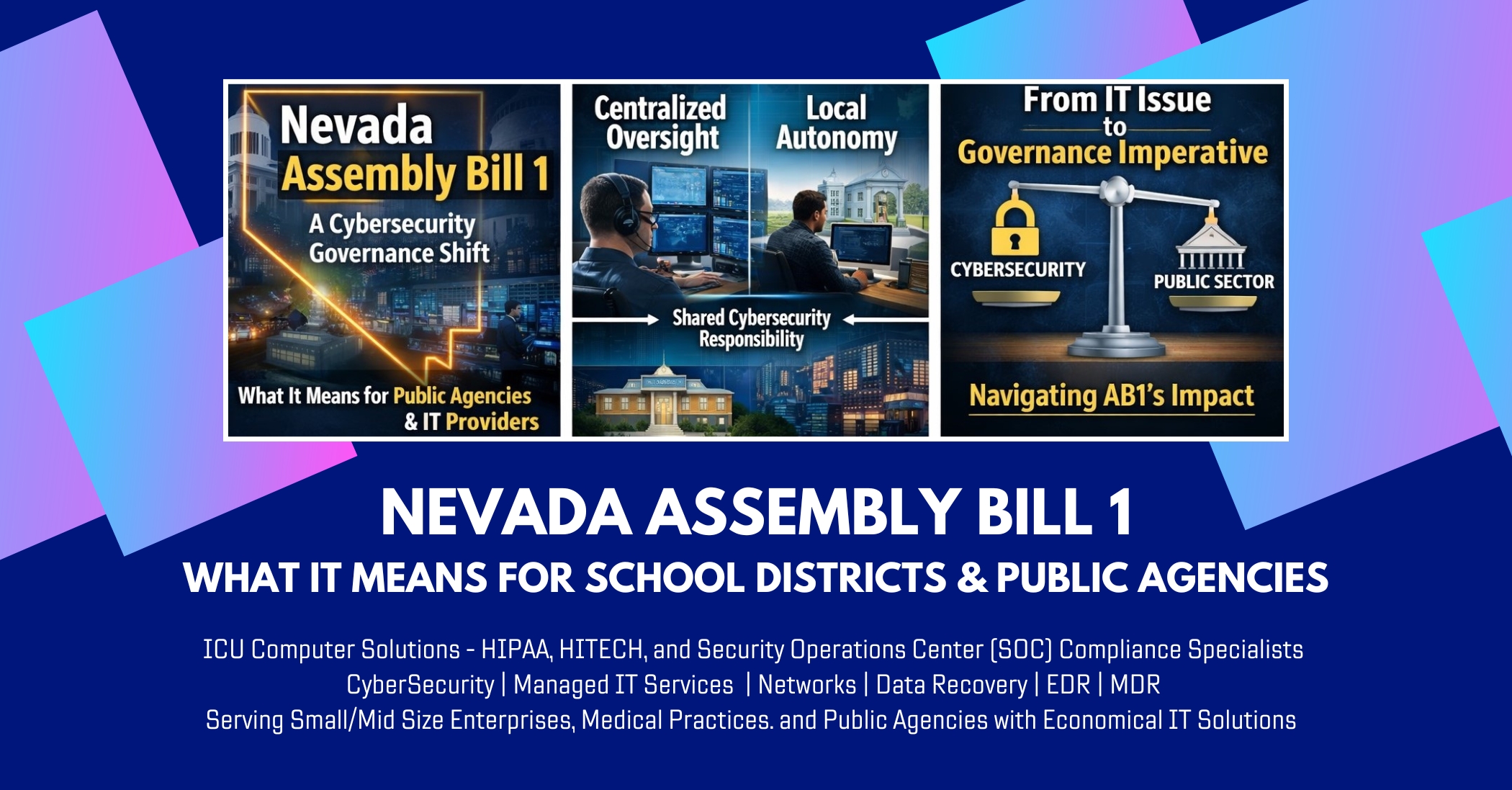
Nevada Assembly Bill 1: Why This Cybersecurity Law Is a Governance Shift — and What It Means for Public Agencies and the Organizations That Support Them
On December 19, 2025, Nevada Governor Joe Lombardo signed Assembly Bill 1 (AB1) into law. While it may appear at first glance to be a technical or administrative update to the state’s cybersecurity framework, AB1 represents something far more consequential.
AB1 is not just a cybersecurity bill—it is a governance shift.
For the first time, Nevada has formally centralized cybersecurity oversight, incident coordination, enforcement authority, and standards under a newly established Security Operations Center (SOC) within the Governor’s Technology Office. At the same time, the law deliberately preserves operational autonomy for school districts, municipalities, and other local governmental agencies—creating a new, shared-responsibility model for cybersecurity across the state.
For public agencies, this changes expectations, obligations, and accountability.For organizations that support them—including technology service providers—this law reshapes the entire operating environment.
At ICU Computer Solutions, we see AB1 as a pivotal moment: one that elevates cybersecurity from an IT concern to a core element of public-sector governance.
This article explains what AB1 actually does, why it matters, and how organizations can navigate this shift safely and strategically.
What Assembly Bill 1 Actually Does
Assembly Bill 1 establishes a comprehensive, statewide cybersecurity framework with several key components:
1. Creation of a Statewide Security Operations Center (SOC)
AB1 formally creates a Security Operations Center within the Office of Information Security and Cyber Defense, housed under the Governor’s Technology Office. This SOC is responsible for:
- Real-time monitoring of cyberinfrastructure
- Threat mitigation and incident response coordination
- Cybersecurity enforcement
- Development of statewide cybersecurity policies and standards
- Annual reporting on cybersecurity effectiveness
This is no longer an advisory function. The SOC has authority, visibility, and accountability across all “using agencies.”
2. Expansion of Who Is Covered — Including School Districts
One of the most significant changes in AB1 is the expanded definition of “local governmental agency.”
School district boards of trustees are now explicitly included, granting them access to—and responsibility for—state cybersecurity services.
This brings K-12 education systems directly into the state cybersecurity framework, recognizing the reality that schools are increasingly targeted by ransomware and data breaches.
3. Mandatory Cybersecurity Policies, Standards, and Reporting
Under AB1, the SOC must develop cybersecurity policies and procedures designed to:
- Combat cybercriminal threats
- Protect sensitive data
- Ensure coordinated and rapid incident response
Using agencies are required to adhere to these standards and report suspected incidents to both the SOC and the Office of Information Security and Cyber Defense.
If an agency fails to comply, the Chief Information Officer may impose additional oversight or audit requirements.
Cybersecurity compliance is no longer optional, informal, or discretionary.
4. A Crucial Limitation: The SOC Does Not Take Operational Control
One of the most misunderstood—and most important—sections of AB1 is what it does not do.
The law explicitly states that while the SOC provides monitoring, standards, and enforcement:
The Security Operations Center is prohibited from assuming operational control of the equipment or software systems of a using agency.
This distinction matters.
Local agencies remain responsible for:
- Their infrastructure
- Their systems
- Their remediation actions
- Their day-to-day operations
The SOC governs, monitors, and coordinates—but it does not run local environments.
This creates a clear operational gap—and a critical role for trusted private-sector partners.
Why AB1 Represents a Governance Shift, Not Just a Technical Change
Historically, cybersecurity in public agencies often lived in a gray zone:
- Best-effort policies
- Limited visibility
- Fragmented responsibility
- Reactive incident response
AB1 changes that model.
Cybersecurity is now treated as:
- A statewide public safety concern
- A governance responsibility
- A regulated operational requirement
This shift reflects the evolution of financial controls, public records, and emergency management over time—from informal practices to codified governance systems.
For agency leaders, this means:
- Cybersecurity decisions now carry policy and compliance implications
- Incident response has legal, operational, and reporting consequences
- Vendor relationships must align with state standards
For service providers, it means:
- Technical competence alone is no longer sufficient
- Alignment with state frameworks is essential
- Documentation, coordination, and accountability matter as much as tools
The New Reality for School Districts and Local Governments
AB1 places particular pressure on resource-constrained agencies, including school districts and municipalities.
Many of these organizations:
- Lack of in-house cybersecurity teams
- Operate aging infrastructure
- Depend heavily on third-party IT providers
- Face increasing ransomware and phishing attacks
Yet under AB1, they are now required to:
- Align with SOC policies
- Maintain incident reporting readiness
- Support real-time monitoring coordination
- Remediate findings without losing operational control
This is not a trivial lift.
It requires:
- Strategic planning
- Technical execution
- Policy alignment
- Ongoing operational discipline
Where ICU Computer Solutions Fits Into the AB1 Framework
At ICU Computer Solutions, our role is not to replace the State SOC.
Our role is to help organizations operate safely within it.
1. SOC-Ready Readiness & Compliance Assessments
Before agencies can align with SOC standards, they must understand their current posture.
ICU provides structured cybersecurity readiness assessments that help organizations:
- Identify gaps relative to SOC policies
- Improve incident reporting workflows
- Strengthen endpoint, network, and identity security
- Reduce audit and oversight risk
This proactive approach is far more effective—and far less costly—than reacting after enforcement actions occur.
2. Operational Execution Without Loss of Control
Because the SOC cannot take over local systems, agencies still need:
- Endpoint protection
- Network security management
- Backup and recovery
- Identity and access control
- Remediation execution
ICU serves as the operational execution partner, ensuring systems remain secure, compliant, and responsive—while coordinating with state monitoring and escalation requirements.
3. Incident Coordination and Response Support
AB1 emphasizes coordinated and rapid response.
That coordination only works if agencies have:
- Clear incident playbooks
- Defined escalation paths
- Technical response capability
- Documentation and reporting discipline
ICU helps agencies build and operate these capabilities—before incidents occur.
4. Long-Term Cybersecurity Governance Support
AB1 is not a one-time compliance event. It establishes an ongoing governance framework.
ICU supports organizations with:
- Continuous monitoring and improvement
- Policy alignment updates
- Staff training and awareness
- Strategic cybersecurity planning
Grants, Talent Pipelines, and the Long View
AB1 also authorizes:
- Pooling of federal cybersecurity grants
- Development of a Cybersecurity Talent Pipeline Program in collaboration with Nevada’s higher-education system
These provisions signal long-term investment, not short-term reaction.
Organizations that align early will be best positioned to:
- Participate in grant-funded initiatives
- Access trained cybersecurity talent
- Build sustainable security programs
Final Thoughts: Navigating the Shift Safely
Assembly Bill 1 formalizes what many organizations already know: cybersecurity is no longer optional, peripheral, or purely technical.
It is now a core governance responsibility.
At ICU Computer Solutions, we exist to help organizations navigate that responsibility safely—bridging the gap between policy and practice, between oversight and execution.
If your organization serves the public, works with sensitive data, or supports critical services, now is the time to prepare—not after enforcement, audits, or incidents occur.
Take the Next Step
To learn how your organization can align with Nevada’s new cybersecurity framework:
Schedule a FREE Consultation: 👉 https://www.icucomputer.com/
Request a FREE Cybersecurity Scan & Risk Assessment: 👉 https://www.icucomputer.com/cybersecurity-scan-risk-assessment
Other Blogs You Maybe Interested In


%20%20(1).jpg)
Grow More Efficiently & Safely with ICU Computer Solutions


